ACADEMIC WRITING GUIDE · RESEARCH TIPS
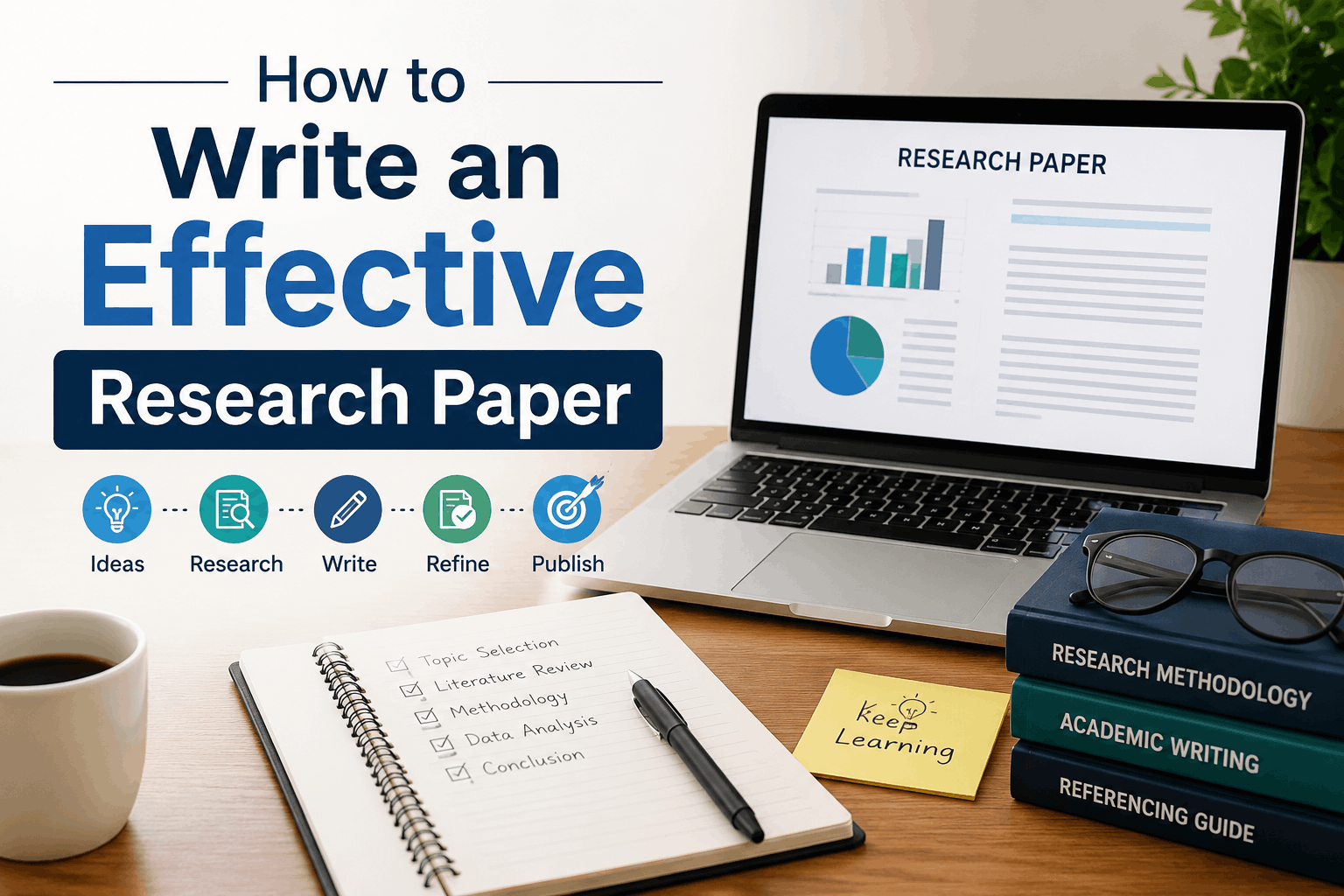
How to Write an Effective Research Paper
A Step-by-Step Guide for Academic Authors
IJTLE — Research & Publishing Blog
By IJTLE Editorial Team | May 2025 | ~700 words
Writing a research paper is one of the most meaningful contributions a scholar can make to their field. Yet many researchers — especially early-career academics and postgraduate students — find the process daunting. Where do you begin? How do you structure your argument? What separates a publishable paper from one that gets rejected at the desk review stage?
This guide walks you through the essential steps of writing an effective, publication-ready research paper — from choosing a focused topic to submitting a polished manuscript to an academic journal.
Choose a Focused and Relevant Research Topic
The foundation of any strong research paper is a well-defined topic. Avoid broad, vague subjects. Instead, identify a specific research gap — a question that existing literature has not fully answered.
Ask yourself: What problem am I addressing? Who will benefit from this research? Is this topic relevant to current debates in my field?
In disciplines like education, English language teaching, or social sciences, a focused topic might be: “The effect of formative assessment on student engagement in blended learning environments.”
Conduct a Thorough Literature Review
A literature review is not a summary of what others have written — it is a critical synthesis that demonstrates your understanding of the field and justifies the need for your study.
Tip: Use academic databases such as Google Scholar, ERIC, JSTOR, or Scopus. Prioritise recent peer-reviewed sources.
Define a Clear Research Objective and Questions
Every research paper must have clearly stated research objectives and questions. These guide the entire structure of your paper and communicate your study’s purpose.
Select an Appropriate Research Methodology
Your methodology section explains how you conducted your research. Describe your design, data sources, instruments, and analytical procedures clearly.
“A well-written methodology section gives reviewers confidence that your findings are credible and justified.”
Structure Your Paper Correctly
-
Introduction — Background and objectives
-
Literature Review — Critical synthesis
-
Methodology — Research design
-
Results — Findings
-
Discussion — Interpretation
-
Conclusion — Summary and future scope
-
References — APA 7th Edition
Write a Compelling Abstract
A strong abstract (150–250 words) should clearly state the purpose, methodology, key findings, and significance of your study.
Choose the Right Keywords
Keywords improve discoverability in search engines and academic databases. Select 5–8 relevant terms.
Revise, Proofread, and Format Before Submission
Ensure clarity, coherence, and proper formatting. Run plagiarism checks and verify citations before submission.
Before submission, ask: Does my paper make an original contribution? Is the methodology clear? Is it well-written?
Final Thoughts
An effective research paper is built on clarity, rigour, and originality. It must be precise, evidence-based, and valuable to the scholarly community.
TAGS: Research Paper Writing · Academic Writing · IMRaD Structure · Literature Review · Research Methodology · Abstract Writing · Journal Submission Tips · IJTLE
International Journal of Teaching, Learning and Education (IJTLE) · Peer-Reviewed · Open Access · COPE Compliant



 | ISSN: 2583-4371