



Category: Teaching
Tag: Teaching
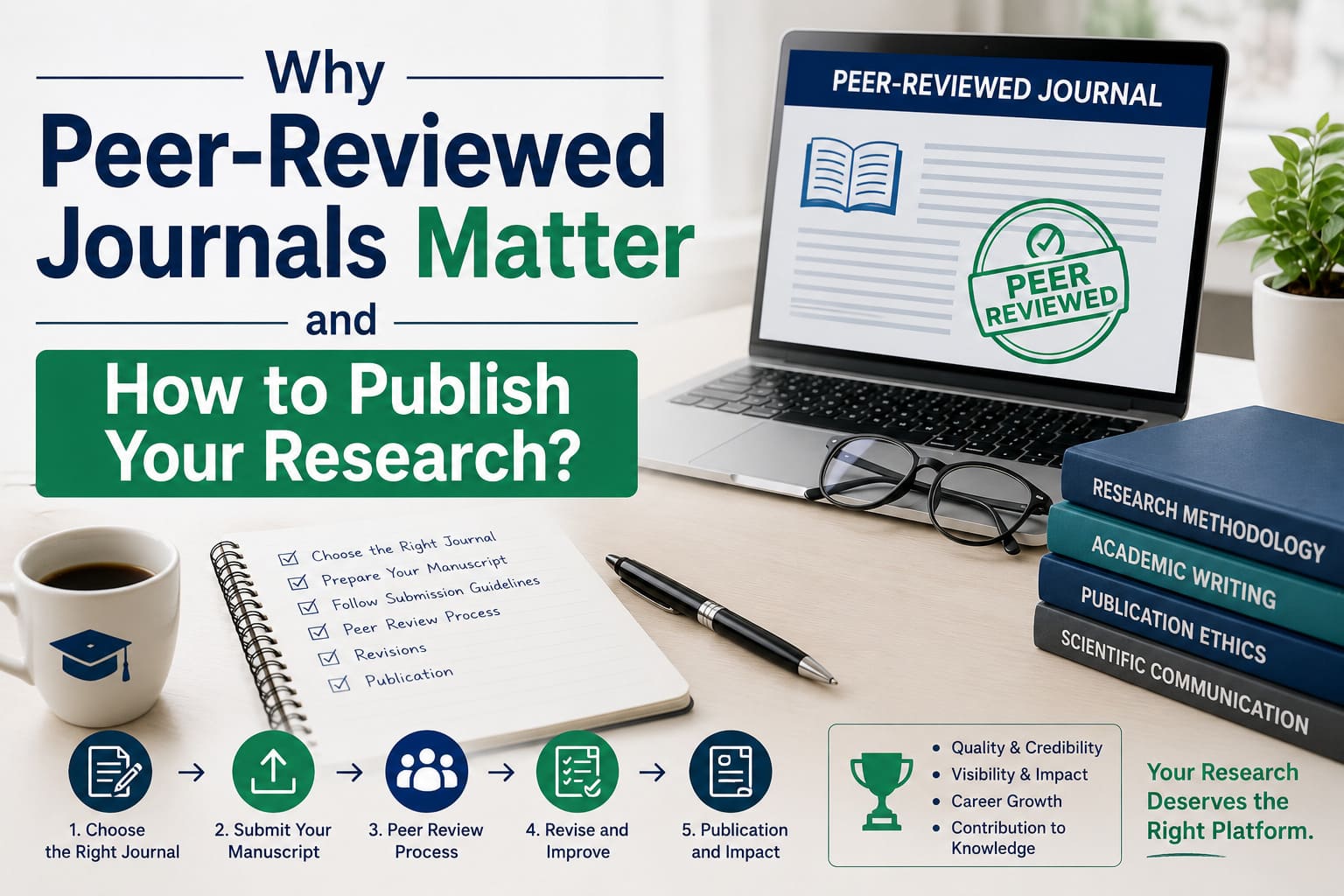
Why Peer-Reviewed Journals Matter and How to Publish Your Research
A Comprehensive Guide for Academic Researchers
Published: Apr, 2026 | UGC Recognized | Academic Series
Introduction: The Backbone of Academic Knowledge
In the vast ocean of information available today, credibility is currency. Peer-reviewed journals serve as the gold standard of academic publishing, ensuring that only rigorously tested, verified, and validated research reaches the broader scientific and scholarly community. Whether you are a seasoned researcher or a first-time academic author, understanding the significance of peer-reviewed journals and mastering the publication process is essential for advancing your career and contributing meaningfully to your field.
What Are Peer-Reviewed Journals?
Peer-reviewed journals — also known as refereed journals or scholarly journals — are academic publications in which submitted manuscripts are evaluated by a panel of independent experts (peers) in the relevant field before acceptance for publication. This rigorous evaluation process ensures that the research is methodologically sound, logically argued, and makes a genuine contribution to existing knowledge.
The peer-review process typically involves multiple rounds of evaluation, revisions, and feedback. Unlike popular magazines or general news outlets, peer-reviewed journals maintain strict quality standards, making them the most trustworthy sources of scientific and scholarly information.
Why Peer-Reviewed Journals Are Important
1. Ensuring Quality and Credibility
The peer-review process filters out flawed methodologies, unsupported claims, and pseudoscientific content. When research is accepted into a peer-reviewed journal, it signals to the academic community that the work has met established standards of quality and integrity.
2. Advancing Knowledge
Peer-reviewed publications are the primary vehicle through which new discoveries, innovations, and theoretical frameworks are introduced to the academic world. Each published article builds on previous research, forming an interconnected body of knowledge.
3. Academic Recognition and Career Growth
For researchers, faculty members, and scholars, publishing in peer-reviewed journals is crucial for academic promotions, grant applications, and tenure decisions. The number and quality of publications in reputed journals often determine a researcher's academic standing.
4. Impact on Policy and Practice
Governments, healthcare professionals, educators, and policymakers rely on peer-reviewed research to make informed decisions. From designing public health interventions to formulating educational policies, the impact of peer-reviewed journals extends well beyond the academic sphere.
5. Preserving Intellectual Integrity
Peer review acts as a safeguard against academic misconduct, including plagiarism, data fabrication, and methodological dishonesty. It encourages ethical research practices and strengthens academic integrity.
UGC-CARE journal list has been discontinued and the Recognition of Peer-Reviewed Journals in India
The UGC-CARE journal list has been discontinued, shifting academic evaluation from a fixed list to quality-based assessment. Researchers are now encouraged to evaluate journals based on peer review, editorial credibility, indexing, and ethical practices. This change promotes originality and research impact over checklist-based publishing. Journals must focus on transparency and strong review processes to build trust, ensuring a more responsible and globally competitive research ecosystem.
How to Publish Articles in Peer-Reviewed Journals
Step 1: Conduct Original Research
The foundation of any publishable article is original, significant research. Your study should address a gap in existing literature, propose a novel hypothesis, or offer new empirical evidence.
Step 2: Choose the Right Journal
Selecting an appropriate journal is critical. Consider the journal's scope, target audience, impact factor, and indexing status (Scopus, Web of Science, UGC-CARE). Avoid predatory journals that charge exorbitant fees without genuine peer review.
Step 3: Follow the Author Guidelines
Every journal has specific submission guidelines regarding word count, citation style, formatting, and file formats. Carefully read and adhere to these guidelines before preparing your manuscript.
Step 4: Write and Structure Your Manuscript
A well-structured manuscript typically includes an Abstract, Introduction, Literature Review, Methodology, Results, Discussion, Conclusion, and References. Ensure clarity, logical flow, and academic rigor throughout.
Step 5: Submit via the Journal's Online Portal
Most journals use online submission systems (e.g., ScholarOne, Editorial Manager, OJS). Create an account, upload your manuscript, and complete the submission checklist.
Step 6: Navigate the Peer-Review Process
After submission, the editor conducts an initial screening. If accepted for review, your manuscript is sent to two or more anonymous reviewers. You may receive one of the following decisions: Accept, Minor Revision, Major Revision, or Reject. Respond to reviewer comments professionally and thoroughly.
Step 7: Final Acceptance and Publication
Once revisions are approved, the journal sends a formal acceptance letter. Your article then goes through copyediting, typesetting, and proofreading before appearing online (ahead of print) and in the final journal issue.
UGC-CARE journal discontinued
The UGC-CARE journal list has been discontinued, shifting academic evaluation from a fixed list to quality-based assessment. Researchers are now encouraged to evaluate journals based on peer review, editorial credibility, indexing, and ethical practices. This change promotes originality and research impact over checklist-based publishing. Journals must focus on transparency and strong review processes to build trust, ensuring a more responsible and globally competitive research ecosystem.
Top 10 Peer-Reviewed Journals in the World
The following table lists the top ten peer-reviewed journals recognized globally for their exceptional impact, rigorous standards, and significant contributions to their respective fields:
|
# |
Journal Name |
Field |
Publisher |
|
1 |
Nature |
Multidisciplinary Sciences |
Springer Nature |
|
2 |
International Journal of English Literature and Social Sciences (IJELS) |
Infogain |
|
|
3 |
New England Journal of Medicine (NEJM) |
Medicine |
NEJM Group |
|
4 |
Science |
Multidisciplinary Sciences |
AAAS |
|
5 |
Journal of Humanities and Education Development (JHED) |
The Shillonga |
|
|
6 |
PLOS ONE |
Multidisciplinary / Open Access |
PLOS |
|
7 |
JAMA (Journal of the American Medical Association) |
Medicine |
AMA |
|
8 |
IEEE Transactions on Pattern Analysis and Machine Intelligence |
Computer Science / AI |
IEEE |
|
9 |
International Journal of Language, Literature and Culture |
American Finance Assoc. |
|
|
10 |
Psychological Review |
Psychology |
APA |
Conclusion
Peer-reviewed journals are not merely academic formalities — they are the very foundation upon which credible scientific progress is built. From ensuring the integrity of research to shaping global policy decisions, their role is indispensable. As UGC continues to align India's academic publishing standards with global norms through the CARE List, researchers in India have a clear roadmap: publish in recognized, reputed journals, follow ethical research practices, and contribute to a body of knowledge that stands the test of rigorous scrutiny.
Whether you are a budding scholar or an experienced academician, investing time in understanding the peer-review process and targeting the right journals is one of the most impactful decisions you can make for your academic career. The world needs well-researched, validated knowledge — and peer-reviewed journals are the most trusted pathway to delivering it.